Your Development Team Isn't Broken — Your System Is (Here's How to Fix It)
Struggling with slow developers or missed deadlines? Learn why your system—not your team—is the problem and how to fix it fast.
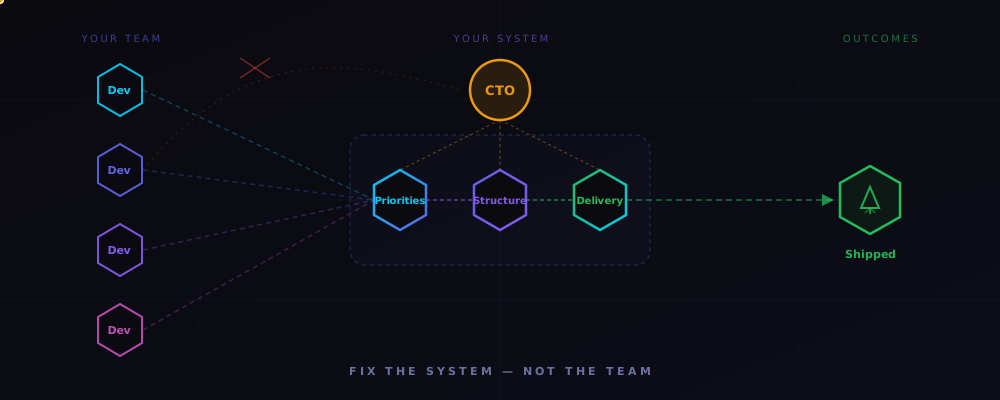
You're investing in developers. You're paying salaries, contractors, or agencies. But somehow:
- Deadlines keep slipping
- Features take longer than expected
- Quality isn't consistent
- And no one can clearly explain why
At some point, the thought creeps in: "Is my dev team just… not good enough?"
Here's the truth most companies miss: your development team isn't the problem — your system is.
The Real Reason Your Dev Team Feels Slow
Most companies assume performance issues come down to:
- Poor developers
- Lack of effort
- Not enough staff
But in reality, 80% of development inefficiencies come from structural problems, not people. The real issues usually look like this:
- No clear technical leadership — the gap a Fractional CTO is built to close
- Weak or non-existent project management
- Constant shifting priorities
- Poor communication between business and tech
- No accountability or delivery structure
Your team isn't failing — they're operating inside a broken system. (For a closer look at why outside expertise often spots this fastest, read how IT consultancy can transform your business.)
What a Broken Development System Looks Like
If any of this sounds familiar, you're not alone:
1. Everything Feels Urgent (But Nothing Gets Finished)
Developers jump between tasks with no clear prioritisation.
Result: lots of work started, very little shipped.
2. Deadlines Are Always “Almost Done”
There's always one more bug, one more tweak, one more delay. Often this is a quality-assurance gap rather than an estimation gap — and disciplined QA testing is what separates “almost done” from actually shipped.
Result: stakeholders lose trust in timelines.
3. Business and Dev Teams Don't Speak the Same Language
Non-technical leadership struggles to translate business goals into technical execution — the exact gap that strong IT consultancy is meant to bridge.
Result: developers build the wrong things — correctly.
4. You Keep Thinking “We Need More Developers”
So you hire more people… but nothing actually improves. If you genuinely do need more capacity, the answer is rarely raw headcount — it's a structured, embedded team. That's why we offer managed development teams rather than just bodies.
Result: costs go up. Output stays the same.
The Hidden Cost of Ignoring This Problem
This isn't just frustrating — it's expensive:
- Delayed product launches
- Lost revenue opportunities
- Increased development costs
- Burnt-out teams
- Missed market windows
And worst of all: you start losing confidence in your own product and your own team.
The Real Fix (That Most Companies Miss)
You don't fix this by:
- Hiring more developers
- Switching tools
- Forcing Agile ceremonies
You fix it by introducing structure, accountability, and technical leadership.
This is where most growing companies hit a wall. They don't need more code — whether that's a new custom software build, a SaaS platform, or a mobile app. They need:
- Clear technical direction
- Proper sprint and delivery structure
- A bridge between business and development
- Someone accountable for outcomes, not just output
If you'd like to read more about how this looks in practice, our piece on how an IT consultant boosts business innovation covers a lot of the same ground from a different angle.
Why a Fractional CTO Changes Everything
A Fractional CTO doesn't just “advise”. They:
- Diagnose inefficiencies in your system
- Restructure your development workflow
- Align business goals with technical execution
- Hold teams accountable to delivery
- Ensure you're building the right things
All without the cost of a full-time executive.
What Happens When You Fix the System
When the system improves, everything changes:
- Faster delivery (without more hires)
- Clear priorities and direction
- Higher quality output — powered by a real QA strategy, not last-minute checking
- Better team morale
- Lower long-term costs
And suddenly, your “underperforming” team becomes a high-performing one.
Final Thought
If your development team feels slow, inconsistent, or frustrating, it's not a people problem — it's a system problem. And the good news? System problems are fixable, fast.
If this sounds familiar, it might be time to bring in a Fractional CTO to look at your system from the outside — or pair that with IT consultancy and managed development teams if you need delivery muscle alongside strategy. Get in touch — Zilo helps companies fix broken development workflows, introduce real technical leadership, and improve delivery without increasing headcount, with no long-term commitments. Just clarity, structure, and results.